
🔑 Key Takeaway:UGC-DEB (Distance Education Bureau) approval is what makes an online or distance degree in India legally valid for jobs, government exams, and further studies. Approval is granted session-wise, meaning a university approved for 2024-25
🔑 Key Takeaway:
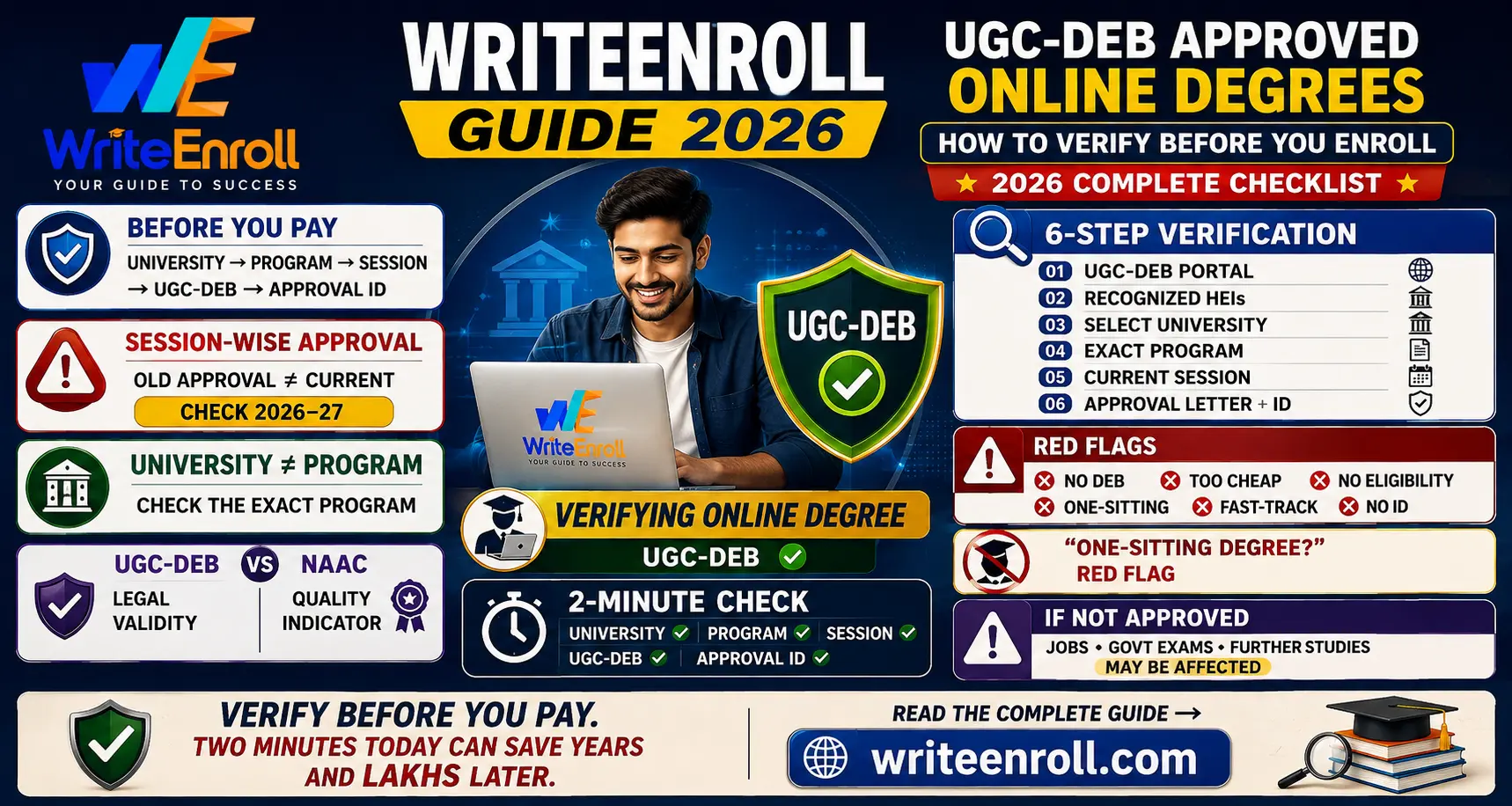
UGC-DEB (Distance Education Bureau) approval is what makes an online or distance degree in India legally valid for jobs, government exams, and further studies. Approval is granted session-wise, meaning a university approved for 2024-25 may not automatically be approved for 2026-27. Always verify the specific university, the specific program, and the current academic session on the official UGC-DEB portal before paying any fee.
Every year, students lose two years and one to three lakh rupees enrolling in online degrees that turn out to be unrecognized. The verification process that would have prevented this takes about two minutes. This guide walks through exactly what UGC-DEB approval means, how to check it yourself, and the warning signs that a program is not what it claims to be.
UGC-DEB stands for University Grants Commission — Distance Education Bureau. It is the regulatory arm of UGC responsible for approving and monitoring which Indian universities may offer degrees through Online and Open Distance Learning (ODL) modes. Without this specific approval — separate from a university's general UGC recognition — any online or distance degree the university offers has no legal standing for employment or further education, regardless of how established the university appears otherwise.
UGC-DEB approval is not permanent — it is granted for a specific academic session and must be renewed. A university's MBA program approved for the 2024-25 session may or may not carry forward to 2026-27. This is the single most common gap that catches students out: they see an old approval screenshot shared online or by an agent and assume it still applies. The only reliable check is the current listing on the official portal for the session you are actually enrolling in.
This process takes about two to three minutes and should be done before paying any application or registration fee.
NAAC (National Assessment and Accreditation Council) accreditation is a separate, additional quality indicator — it does not substitute for UGC-DEB approval. A NAAC B++ grade is commonly treated as the acceptable minimum quality threshold for online/distance programs; A and A++ grades indicate progressively stronger institutional quality. Check both: UGC-DEB approval for legal validity, and NAAC grade for a sense of overall institutional quality.
A handful of warning signs repeat across most fraudulent or unrecognized online degree schemes in India.
A degree from a program without valid UGC-DEB approval carries no legal standing — an employer can reject it outright, a government exam can disqualify your application on this basis, and a foreign visa or credential-evaluation officer can decline to process it. There is generally no straightforward remedy after the fact beyond re-enrolling in a properly approved program, which is precisely why the two-minute check before enrolling is worth doing every single time, even for well-known university names.
Q: Is UGC-DEB approval the same as general UGC recognition?
A: No. General UGC recognition applies to a university broadly; UGC-DEB approval is a separate, specific entitlement required for that university to legally offer online or distance-mode degrees.
Q: If a university was approved last year, is it automatically approved this year?
A: No. Approval is granted session-wise and must be renewed. Always check the current academic session's listing specifically.
Q: Does UGC-DEB approval guarantee good teaching quality?
A: No. It guarantees legal validity of the degree. Teaching quality is better gauged through NAAC accreditation grade, student reviews, and placement track record.
Q: Are online degrees from UGC-DEB approved universities valid for government jobs?
A: Yes. UGC has officially clarified that ODL and online degrees from recognized higher education institutions are treated as equivalent to conventional-mode degrees for employment, including government jobs and competitive exams.
Q: Can I get a refund if I discover after enrolling that my program wasn't approved?
A: This depends entirely on the university's own refund policy and is often difficult to recover in practice, which is why pre-enrollment verification is strongly recommended over post-enrollment dispute.
UGC-DEB verification is the single highest-value two minutes you will spend in your entire admission process. Do it yourself, directly on the official portal, for the specific program and session you intend to join — regardless of how convincing the university's marketing or an agent's assurance sounds.
Suggested Internal Links:
/about/ | /courses/ | /admission/