
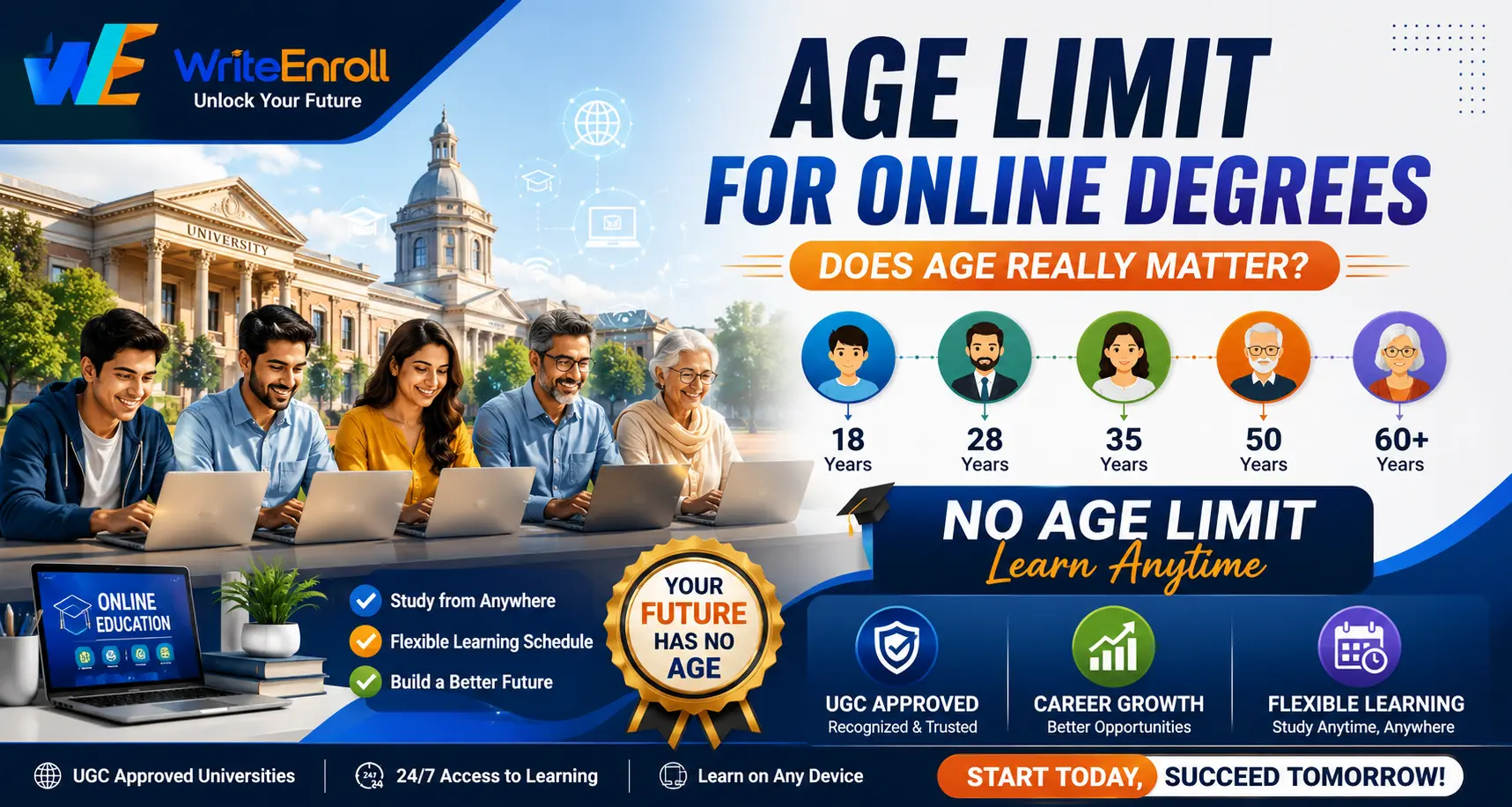
🔑 Key Takeaway:There is no upper age limit for online undergraduate or postgraduate degree admission in India — this is an explicit UGC/DEB regulatory position, not just informal practice. Minimum age requirements exist only implicitly, tied to compl
🔑 Key Takeaway:
There is no upper age limit for online undergraduate or postgraduate degree admission in India — this is an explicit UGC/DEB regulatory position, not just informal practice. Minimum age requirements exist only implicitly, tied to completing the prior qualifying degree (12th grade or bachelor's). Employers increasingly focus on skills and qualification relevance rather than the age at which a degree was completed, though this perception, while strongly improving, is not perfectly uniform across every employer.
"Am I too old to start this degree?" is one of the most common hesitations among prospective online degree students in India, whether they're 28 or 55. This guide gives the direct, regulation-backed answer along with an honest look at real-world perception.
UGC and the Distance Education Bureau (DEB), which jointly regulate online and distance-mode degrees in India, do not impose upper age restrictions for admission at any level — undergraduate or postgraduate. This position exists specifically to support lifelong learning as a policy goal, not as an unenforced technicality universities happen to tolerate. Practically, this means a 45-year-old and a 22-year-old applying to the same online MBA program face identical age-related eligibility — none at all.
While there's no upper limit, a practical minimum age exists implicitly through the qualification requirement itself — you generally need to have completed 12th grade (commonly around age 17-18) for undergraduate admission, or a bachelor's degree for postgraduate admission. Beyond this, no additional age-based eligibility layer applies for standard online degree programs. (Note: this differs for certain premium or executive-track programs, such as an Executive MBA, which may set a minimum work-experience requirement — a related but distinct concept from age itself.)
Your date of birth is typically collected as standard admission information, but it functions as identity/record data rather than an eligibility filter. A small number of universities set an informal minimum age (commonly around 17) tied to the expected completion age of 12th grade — this is about ensuring baseline qualification completion, not screening out older applicants.
Employer attitudes have shifted substantially — most employers today report focusing on whether a candidate's skills and qualification are relevant to the role, not the age at which the qualification was obtained. That said, this perception, while strongly and consistently improving, is not perfectly uniform: a small number of employers or specific roles may still implicitly favor candidates who completed qualifications at a "traditional" age, particularly in select conservative industries. This is a genuine, if shrinking, consideration worth being realistic about rather than dismissing entirely — it should not, however, discourage genuine pursuit of a qualification that supports your specific goals.
If age has been holding you back from starting or restarting an online degree, the regulatory answer is unambiguous: there is no barrier. Focus your energy instead on choosing a degree and specialization that genuinely supports a concrete next step — a promotion, a career switch, or a return to the workforce — since this, far more than your age, is what actually determines how the qualification serves you.
Q: Is there an age limit for online MBA specifically?
A: No, online MBA programs in India generally have no upper age restriction — eligibility is based on holding a bachelor's degree with the required minimum marks.
Q: Can a retired person pursue an online degree?
A: Yes, retired professionals can and do pursue online degrees for consulting, entrepreneurship, teaching, or personal academic interest — age is not a barrier.
Q: Do Executive MBA programs have age requirements?
A: They typically require a minimum amount of work experience (commonly 1-5 years for standard executive programs, more for premium IIM-linked ones) rather than a specific age threshold — though these two concepts often correlate in practice.
Q: Will a 40-year-old's online degree be taken less seriously by employers?
A: Generally no for most private-sector roles today, since employer focus has shifted toward skills and qualification relevance — though perception isn't perfectly uniform across every employer or industry.
Q: Is there a minimum age for online degree admission?
A: Only implicitly, tied to completing the prior qualifying degree — commonly around 17 for undergraduate admission (following 12th grade completion) and no separate additional age floor beyond that for postgraduate admission.
Age is not a regulatory barrier to online degree admission in India at any level — this is settled UGC/DEB policy, not informal leniency. The genuinely important decision is choosing a degree that supports a concrete goal, not whether you've started "too late."
Suggested Internal Links:
/admission/ | /blog/online-degree-courses-for-homemakers-2026/