
🔑 Key Takeaway:Most online MBA programs in India offer Finance, Marketing, Human Resource Management, Operations, and Business Analytics as core specialization choices. Each leads to a genuinely different career path and daily work style. Choosing th
🔑 Key Takeaway:
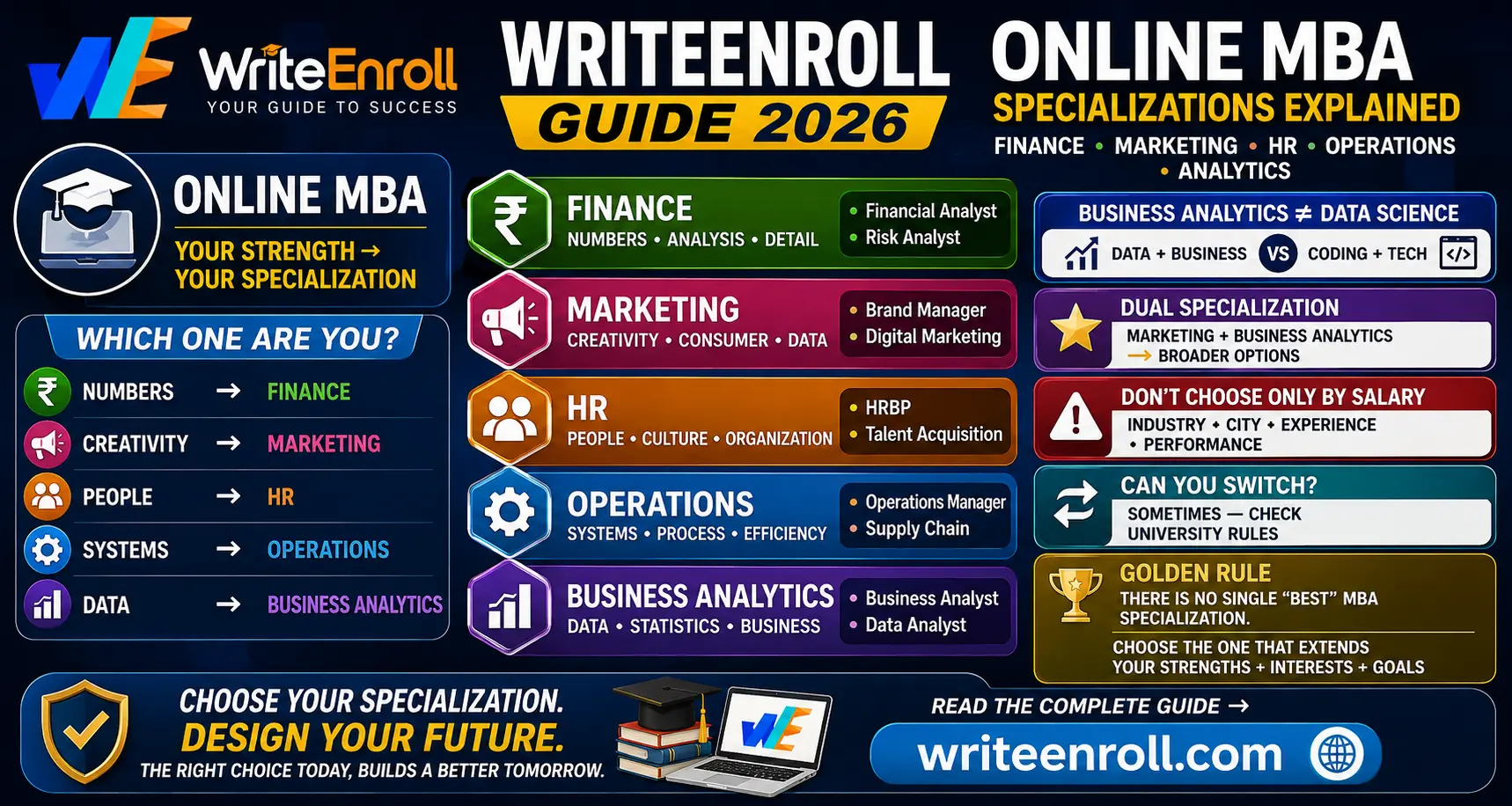
Most online MBA programs in India offer Finance, Marketing, Human Resource Management, Operations, and Business Analytics as core specialization choices. Each leads to a genuinely different career path and daily work style. Choosing the right one depends on your existing background, natural strengths, and the industry you want to work in — not which one "pays more" in a generic ranking.
An online MBA application form usually asks you to pick a specialization before you've had much exposure to what each one actually involves day-to-day. This guide explains what each major specialization really covers, what kind of person tends to enjoy it, and what career paths typically follow — so the choice on your application form is an informed one.
Finance specialization covers corporate finance, financial markets, investment analysis, risk management, and financial modeling. It suits students who are comfortable with numbers and enjoy analytical, detail-heavy work. Career paths include financial analyst, investment banking associate, corporate finance manager, and credit/risk analyst roles at banks and NBFCs. A commerce or economics background at graduation is helpful but not mandatory.
Marketing specialization covers consumer behaviour, brand management, digital marketing, market research, and sales strategy. It suits students who enjoy creative thinking combined with data-driven decision-making. Career paths include brand manager, digital marketing manager, product marketing associate, and market research analyst. This specialization has grown particularly fast in demand as Indian D2C and e-commerce brands scale up their marketing teams.
HR specialization covers talent acquisition, compensation and benefits, organizational development, labour law, and performance management systems. It suits students who are genuinely interested in people, workplace culture, and organizational psychology rather than pure numbers. Career paths include HR business partner, talent acquisition manager, compensation analyst, and organizational development consultant.
Operations specialization covers supply chain management, logistics, process optimization, quality management, and project management. It suits students who enjoy systems thinking and improving efficiency in complex processes. Career paths include operations manager, supply chain analyst, logistics coordinator, and process improvement consultant — roles that exist across manufacturing, retail, e-commerce, and logistics companies alike.
Business Analytics is the newest and fastest-growing specialization, covering data analysis, statistical modeling, dashboarding tools, and data-driven decision-making applied to business problems (as opposed to pure technical data science). It suits students comfortable with data and basic statistics who want to combine analytical skill with business context. Career paths include business analyst, data analyst, and analytics consultant roles across nearly every industry.
A quick side-by-side helps when you are stuck between two options that both sound interesting on paper.
| Specialization | Best Suited For | Typical Entry Role |
|---|---|---|
| Finance | Numbers-oriented, detail-focused thinkers | Financial/Credit Analyst |
| Marketing | Creative + data-driven thinkers | Brand/Marketing Executive |
| HR | People-focused, culture-interested thinkers | HR Business Partne |
| Operations | Systems and process-oriented thinkers | Operations Manage |
| Business Analytics | Data-comfortable, business-context thinkers | Business/Data Analyst |
Rather than picking based on which specialization "sounds impressive," look back at your undergraduate coursework or work experience and identify what you consistently enjoyed and did well in — analysing numbers, communicating with people, organizing processes, or working with data. Your specialization should extend an existing strength rather than force an entirely new one, since the two-year program is not long enough to build deep expertise from a standing start in an unfamiliar area.
Q: Can I switch my MBA specialization after enrolling?
A: Usually only within a short window at the start of the first semester, and not all universities allow it. Choose carefully before applying.
Q: Which online MBA specialization has the highest starting salary?
A: This varies by industry, city, and individual performance far more than by specialization alone. Finance and Business Analytics often show slightly higher entry salaries in metro cities, but the gap narrows quickly with experience across all specializations.
Q: Do I need a related undergraduate background for a specific specialization?
A: It helps but is rarely mandatory. Most universities accept graduates from any stream into any MBA specialization, though a related background makes the coursework more familiar.
Q: Is Business Analytics the same as Data Science?
A: No. Business Analytics applies data analysis to business decision-making within an MBA framework, while Data Science is a more technical, coding-heavy discipline typically pursued through a dedicated M.Sc. or MCA-level program.
Q: Is dual specialization available in online MBA programs?
A: Yes, many universities now offer dual-specialization online MBA programs (for example, Marketing + Business Analytics), which can broaden career options at a modestly higher fee.
There is no single "best" MBA specialization — only the one that genuinely extends your existing strengths and interests. Use the comparison above as a starting filter, but make the final call based on honest self-assessment of what kind of work you actually enjoy doing.
Suggested Internal Links:
/courses/online-mba/ | /courses/online-mba-dual-specialization/ | /blog/online-mba-complete-guide-2026/