
🔑 Key Takeaway:Online M.Sc typically costs Rs 30,000-2,50,000 with live classes and virtual lab access, while Distance M.Sc is generally more affordable but offers less structured interaction. As with B.Sc, the right choice depends heavily on your sp
🔑 Key Takeaway:
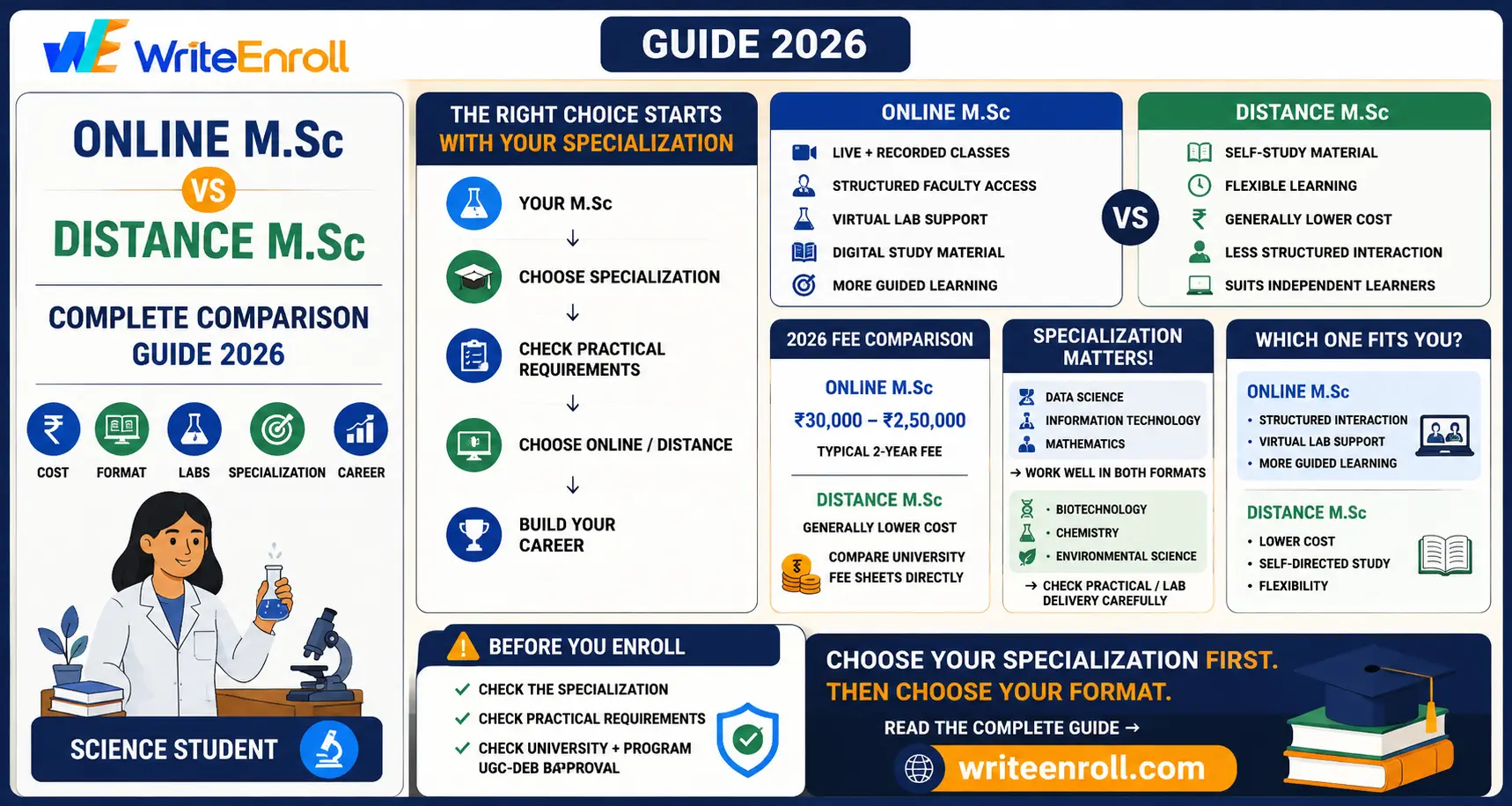
Online M.Sc typically costs Rs 30,000-2,50,000 with live classes and virtual lab access, while Distance M.Sc is generally more affordable but offers less structured interaction. As with B.Sc, the right choice depends heavily on your specialization — computational tracks (Data Science, IT, Mathematics) suit either format well, while lab-dependent sciences need closer attention to how practical components are actually delivered.
The online-versus-distance decision at the M.Sc level carries the same specialization-dependent nuance seen at the B.Sc level, since practical/lab requirements vary significantly by subject. This guide applies that lens specifically to the postgraduate stage.
Online M.Sc delivers coursework through live and recorded lectures, virtual labs, and digital study material with more structured faculty access. Distance M.Sc relies more heavily on self-study material with limited live interaction, generally at a lower cost, and is more commonly chosen by students already comfortable with independent study — often those balancing the degree alongside a full-time technical job.
| Format | Typical Total Fee (2 years) | Best Suited For |
|---|---|---|
| Online M.Sc | Rs 30,000 - Rs 2,50,000 | Learners wanting structured interaction and virtual lab access |
| Distance M.Sc | Generally lower cost than online | Self-motivated learners, working professionals in the same technical field |
As with B.Sc, computational specializations (Data Science, Information Technology, Mathematics) transfer well to either fully-online or distance delivery since they require minimal physical lab work. Specializations requiring wet-lab or field-based practical training (certain Biotechnology, Chemistry, or Environmental Science tracks) need closer verification of exactly how the university delivers practical components, regardless of whether the program is labeled online or distance.
If you're already working in a technical role related to your M.Sc specialization and are comfortable with self-directed study, Distance M.Sc offers a genuinely cost-effective path to the qualification. If you want more structured faculty access and virtual lab support, particularly for a specialization you're less familiar with, Online M.Sc is the safer choice despite the somewhat higher cost.
Q: Is Distance M.Sc valid for government jobs?
A: Yes, provided the university and program hold current UGC-DEB approval, on the same equivalence basis as other distance degrees.
Q: Which M.Sc specializations work best in distance mode?
A: Computational specializations like Data Science, IT, and Mathematics work well in distance mode since they don't require physical lab access.
Q: Is there a big fee difference between online and distance M.Sc?
A: Distance M.Sc is generally somewhat more affordable, though the exact gap varies significantly by university and specialization — compare specific fee sheets directly.
Q: Can I switch from distance to online M.Sc mid-program?
A: This depends entirely on the specific university's policy and is not guaranteed — check before enrolling if this flexibility matters to you.
Q: Do both formats lead to the same degree certificate?
A: In most cases the final degree certificate does not distinguish the delivery mode, though this can vary by university — confirm directly if this matters to you.
Online M.Sc and Distance M.Sc both lead to a valid postgraduate science qualification. Choose based on your specialization's practical requirements first, then weigh cost against your need for structured interaction.
Suggested Internal Links:
/courses/online-msc/ | /courses/distance-msc/ | /blog/online-msc-complete-guide-2026/