
🔑 Key Takeaway:Online M.Sc is a 2-year UGC-recognized postgraduate science degree requiring a relevant bachelor's degree for admission. Total fees typically range from Rs 30,000 to Rs 2,50,000 depending on the university and specialization. Data Scie
🔑 Key Takeaway:
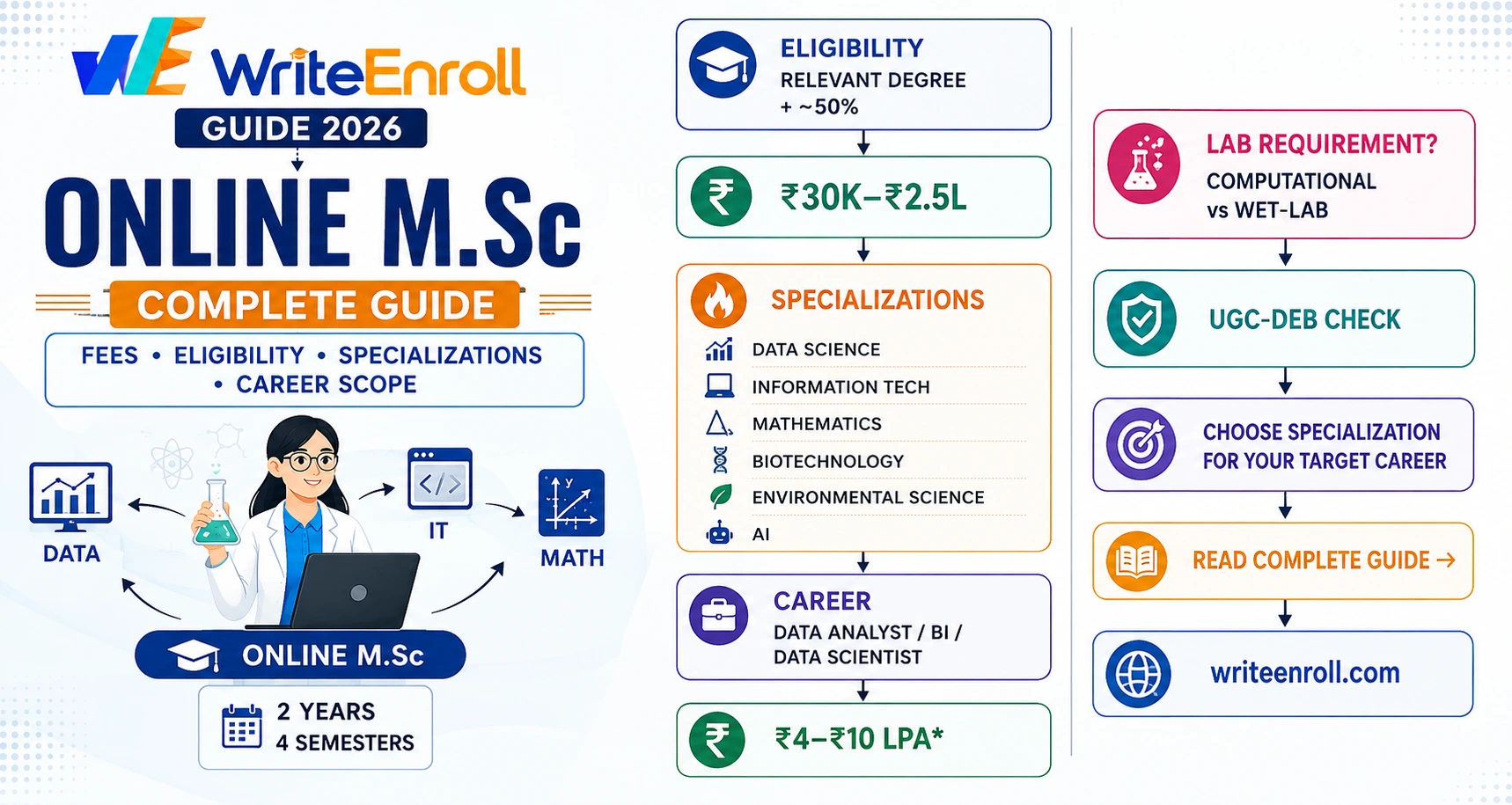
Online M.Sc is a 2-year UGC-recognized postgraduate science degree requiring a relevant bachelor's degree for admission. Total fees typically range from Rs 30,000 to Rs 2,50,000 depending on the university and specialization. Data Science, Information Technology, and Mathematics are currently the fastest-growing specializations by enrollment, offering strong career scope in analytics and technology roles.
An online M.Sc is often overlooked in discussions that default to MBA or MCA, yet it is one of the most direct routes into analytics, data science, and technology-adjacent careers for science graduates. This guide covers what the degree actually involves, current fees, and which specializations are worth prioritizing in 2026.
Master of Science (M.Sc) is a 2-year postgraduate degree that builds advanced, specialized knowledge in a chosen scientific discipline. The online mode delivers coursework through recorded and live lectures, digital study material, virtual labs where applicable, and online assessments across four semesters, making it accessible to working professionals in technical roles who want a formal postgraduate qualification without a career break.
The specialization landscape has shifted noticeably in the last two years. Data Science and Information Technology have overtaken traditional pure-science specializations in enrollment numbers, driven by strong industry demand. Other widely offered specializations include Mathematics, Environmental Science, Biotechnology, and increasingly Artificial Intelligence as a distinct elective track. Data Science coursework typically covers Python, machine learning fundamentals, statistics, and data visualization; Information Technology coursework covers network security, database systems, and emerging IT infrastructure trends.
Total fees for the 2-year program vary considerably by specialization and university, generally falling between Rs 30,000 at government/open universities and Rs 2,50,000 at premium private universities offering Data Science or AI-focused tracks. Application fees are typically modest, in the Rs 650-1,900 range, separate from the semester fee structure.
Career paths vary significantly by specialization. Data Science and IT graduates commonly move into roles such as data analyst, business intelligence associate, and junior data scientist, with entry-level salaries commonly in the Rs 4-10 LPA range depending on city and specific technical skills demonstrated beyond the degree itself. Graduates in core science specializations (Mathematics, Environmental Science, Biotechnology) more commonly move into research assistant roles, teaching (subject to NET/SET qualification), or specialized technical roles within their field.
Yes, provided the university and program are UGC-DEB approved. The degree mode itself does not affect eligibility for government recruitment as long as the underlying qualification is recognized — candidates should still verify the specific eligibility criteria listed in individual job notifications, since some roles specify additional requirements beyond the base degree.
Q: Can a BCA graduate pursue online M.Sc in Data Science?
A: Yes, BCA is commonly accepted as a relevant background for M.Sc Computer Science or Data Science specializations, though requirements vary slightly by university.
Q: Is online M.Sc as valuable as a regular M.Sc for research careers?
A: For most industry roles, yes, provided the university is properly accredited. For highly research-intensive academic careers (such as pursuing a PhD at a top institute), an on-campus M.Sc with lab-based research exposure may carry more weight in some cases — evaluate this specifically against your target program's admission criteria.
Q: What is the average fee for online M.Sc in India in 2026?
A: Total fees for the 2-year program typically range from Rs 30,000 to Rs 2,50,000 depending on the university and specialization chosen.
Q: Does online M.Sc require lab work?
A: Depends on specialization. Data Science, IT, and Mathematics specializations are largely computational and suit the online format well. Specializations requiring wet-lab work (certain Biotechnology or Chemistry tracks) may include periodic contact sessions or virtual lab simulations — verify this specifically with your target university.
Q: Can I do an online M.Sc after a B.Com or BA?
A: Generally no, unless the specific specialization explicitly accepts non-science backgrounds. Most M.Sc specializations require a relevant B.Sc, BCA, or equivalent science-stream background.
Online M.Sc, particularly in Data Science and Information Technology, has become one of the more career-relevant postgraduate options for science and computer application graduates in 2026. Choose your specialization based on genuine industry demand in your target city and role, not just familiarity with the subject name.
Suggested Internal Links:
/courses/online-msc/ | /courses/distance-msc/