
🔑 Key Takeaway:B.Tech for Working Professionals is an AICTE-approved lateral-entry pathway that lets diploma holders join the second year of a B.Tech program while continuing to work. Important: this is a blended format — evening/weekend live classes
🔑 Key Takeaway:
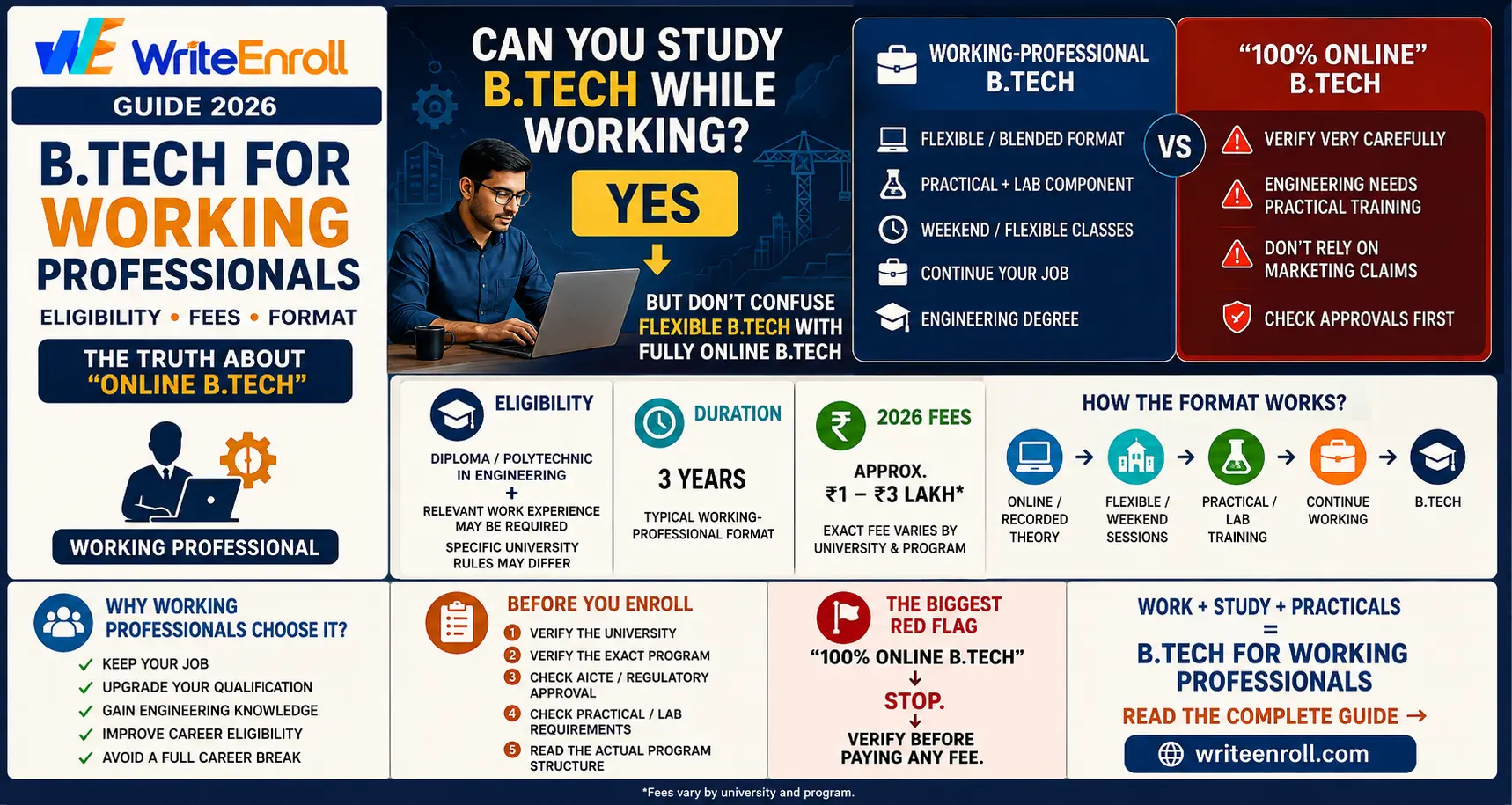
B.Tech for Working Professionals is an AICTE-approved lateral-entry pathway that lets diploma holders join the second year of a B.Tech program while continuing to work. Important: this is a blended format — evening/weekend live classes plus mandatory on-campus lab sessions — not a fully online degree, since AICTE requires physical practical training for engineering degrees. Fees typically range from Rs 35,000 to Rs 57,500 per semester.
B.Tech for Working Professionals is genuinely useful for diploma holders who want a full engineering degree without quitting their job — but it is frequently marketed with "online" language that overstates how remote the program actually is. This guide gives the accurate picture, including the parts most marketing pages skip over.
B.Tech for Working Professionals is a lateral-entry program specifically designed for diploma holders — typically those with a 3-year engineering diploma after 10th grade, or a 2-year diploma after 12th — allowing direct admission into the second year of a B.Tech program. This saves one full year compared to starting a B.Tech from scratch, and the program is structured around evening, weekend, and holiday class schedules to accommodate full-time employment.
A genuinely important clarification that many marketing pages blur: AICTE requires hands-on practical and laboratory training for engineering degrees, which means a fully remote, no-campus-attendance "online B.Tech" is not recognized as valid in India. Legitimate B.Tech for Working Professionals programs are blended — live or recorded lectures accessed remotely, combined with mandatory on-campus laboratory sessions, typically held on Saturdays. Be specifically cautious of any program marketed as "100% online B.Tech" with zero campus requirement, since this does not match how AICTE currently regulates engineering degrees.
Fees vary by university and specialization but commonly fall between Rs 35,000 and Rs 57,500 per semester, plus a one-time registration fee (commonly around Rs 5,000) and a separate exam fee per semester (commonly around Rs 5,000). Across the typical remaining duration after lateral entry, total fees usually land in the broad range of Rs 1,40,000 to Rs 2,50,000.
The core financial case is straightforward: a diploma holder who quits their job to pursue a regular full-time B.Tech loses several years of salary in addition to paying tuition. The working-professional pathway avoids this income loss entirely while still delivering a recognized engineering degree — provided the specific university and program hold current AICTE approval, which should always be verified directly before enrolling.
Typical specializations include Computer Science, Mechanical, Civil, Electrical, and Electronics Engineering, with some universities now adding Data Science, AI, or Cyber Security tracks. Note that not every specialization available in a regular full-time B.Tech program is necessarily offered in the working-professional pathway at every university — confirm your specific specialization is actually available before applying.
Q: Is B.Tech for Working Professionals the same as B.Tech Lateral Entry?
A: They overlap significantly — lateral entry is the admission mechanism (joining directly into the second year after a diploma), and "for Working Professionals" describes the schedule format (evening/weekend/blended) designed around employment. Most working-professional B.Tech programs use lateral entry.
Q: Is a fully distance/online B.Tech valid in India?
A: No. AICTE requires physical practical and laboratory training for engineering degrees, so a program with zero campus requirement is not considered a valid B.Tech pathway. Legitimate working-professional programs are blended, with mandatory on-campus lab components.
Q: Do I need work experience to apply?
A: Many universities require at least 1 year of relevant work experience in addition to the diploma qualification — verify this specifically with your target university.
Q: Will my degree certificate mention "working professional" or "part-time"?
A: In most cases, no — the final degree certificate typically does not distinguish the mode, provided the institute is AICTE approved. Confirm this specifically with your target university if it matters to you.
Q: Can B.Sc graduates apply for B.Tech for Working Professionals?
A: Some universities accept B.Sc graduates with Mathematics and relevant work experience, though the primary eligible group is diploma holders. Check specific university criteria.
B.Tech for Working Professionals is a legitimate, financially sound path for diploma holders — but only when you go in understanding it is a blended format requiring periodic campus attendance, not a fully remote degree. Verify AICTE approval directly and confirm the specific lab-attendance requirements before enrolling.
Suggested Internal Links:
/courses/btech-for-working-professionals/ | /courses/online-btech-after-diploma/